The Short Version
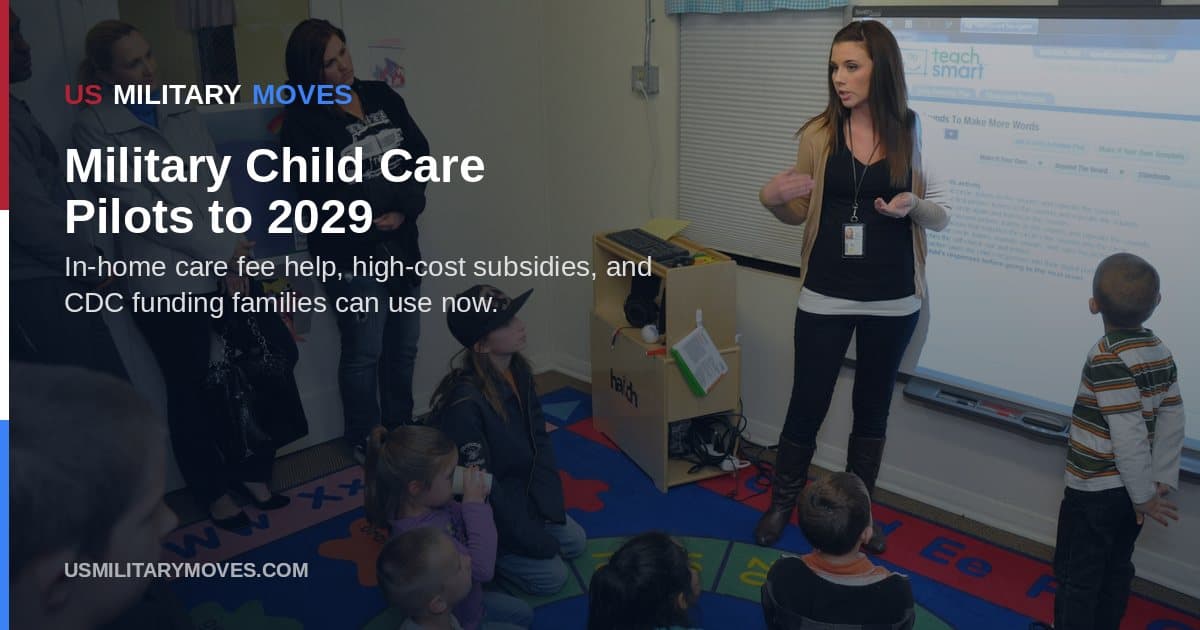
Child care is readiness. When the CDC waitlist is months long, a spouse career stalls and a service member's duty day gets fragile. The FY2026 National Defense Authorization Act, signed in December 2025, put real money and longer authority behind that problem.
- Child Care in Your Home (CCYH): Fee assistance for qualifying in-home care at select high-demand bases, extended through December 31, 2029.
- High-cost-area boost: A multi-year pilot that can raise the monthly subsidy by about 30% per child in designated expensive markets.
- CDC construction: Hundreds of millions authorized to design and build more child development capacity.
What CCYH Actually Is
CCYH is not a free nanny from the government. It is fee assistance that helps eligible families pay a qualified in-home provider when installation care is maxed out.
It runs at a limited set of locations chosen for highest demand and longest waitlists. If your orders point somewhere outside the pilot map, you still use standard CDC, Family Child Care, and Military Child Care in Your Neighborhood (MCCYN) fee assistance where available.
Ask Child and Youth Services, not a Facebook admin, whether the gaining station is in CCYH before you price a nanny you cannot sustain.
High-Cost Markets and the 30% Bump
Even with MCCYN, provider rate caps leave families underwater in coastal and metro MHAs. The high-cost pilot lets DoD raise the maximum subsidy so the math works where infant care routinely clears $2,000 a month.
That bump is per child, per month, and only in designated communities. Keep pay stubs and provider invoices clean. Finance and CYS will not reconstruct a messy paper trail after the fact.
How This Ties to Housing and PCS Timing
Child care access should sit on the same spreadsheet as BAH and commute time. A cheap rental an hour from the CDC can erase a spouse salary. A waitlist with no backup can force a bad on-base or off-base call.
Run buy, rent, or on base only after you know the care plan. EFMP families should also read the EFMP PCS guide because specialty care and child care often move on different clocks.
Pending FY2027 NDAA language may add more CDC dollars and related pilots. Until a final bill is signed, treat that as upside. Details in the FY2027 NDAA explainer.
Action Checklist for the Next 30 Days
- The week orders drop, request CDC and CYS waitlist placement at the gaining station.
- Ask whether CCYH or high-cost fee assistance applies there.
- Price at least one off-base backup provider that already takes MCCYN if available.
- If you are a dual-military or single-parent household, ask about priority categories in writing.
- Put child care deposits into the PCS budget calculator so they do not surprise you next to TLE and rent.
Spouses sequencing careers around care should keep the spouse PCS checklist in parallel.
What To Do Next
- Call gaining CYS before you tour neighborhoods.
- Document every waitlist confirmation number.
- Watch FY2027 conference action for extra CDC funding, but enroll under today's rules.
Longer pilots do not invent open infant rooms overnight. They do give families more ways to pay for care that already exists while DoD builds capacity. Use them early.